Hey Wordies!
I’m delighted to offer the latest instalment of, Five Questions, One Author, a series where we spotlight new, indie, and underrepresented authors. The response to the first interview last week was overwhelmingly positive which is encouraging as I have more fantastic brilliant authors coming up.
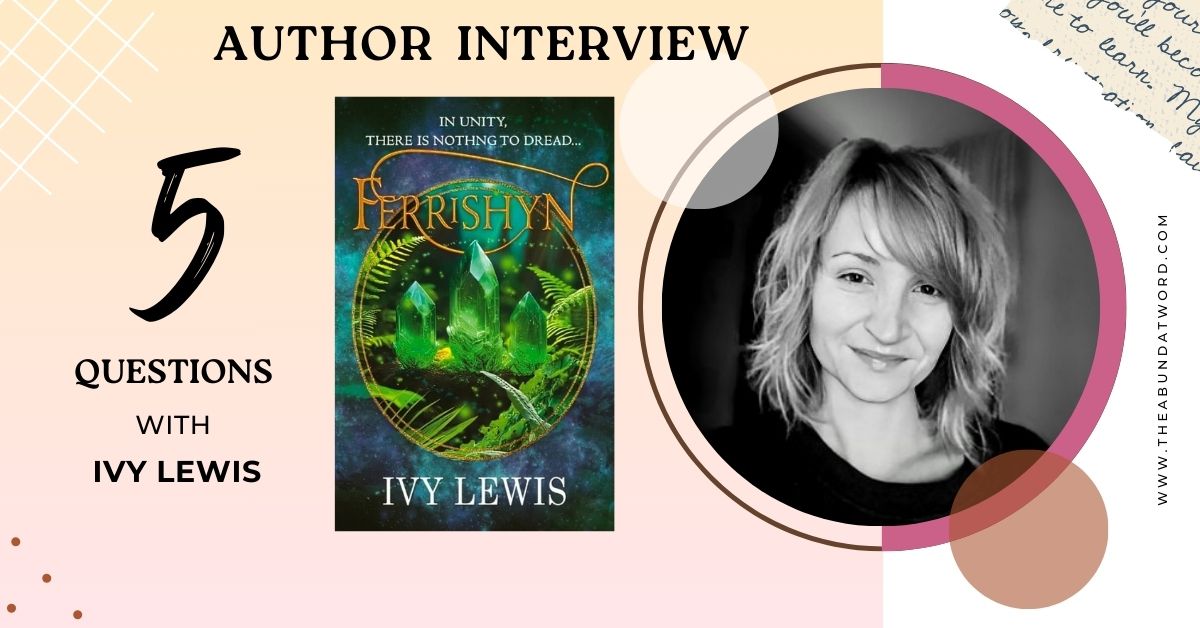
This week we welcome Ivy Lewis, an incredible author whose debut novel, Ferrishyn, is launching this week as the first instalment in an adult romantasy series. I’ve had the privilege of watching this story grow from an early draft, and I couldn’t be happier to see her unforgettable characters finally make their way into the world (and not just because of the sexy fairy soldiers!).
As a neurodivergent writer living with disabilities, Ivy’s journey to publication is nothing short of inspiring. As you will see from this candid interview, Ivy’s rich life experiences—from studying medieval folklore to serving as a in Afghanistan—could easily be a book of their own.
Each post in this series features the same five questions, giving these writers the space to share their stories, inspirations, and lessons learned. A massive thank you to all the authors who are taking part.
Now that’s been said, grab a cuppa and a sweet treat Wordies, let’s begin!

This post contains affiliate links. If you click any of these links and make a purchase within a certain timeframe, I may earn a commission, at no extra cost to you.

- What inspired you to start writing, and what led you to choose self-publishing or working with an independent/small publisher?
I’ve been writing since I was fifteen. When I was sixteen I self-published an epic fantasy duology through Lulu and a couple of novellas. These books were obviously terrible, but I loved creating worlds. I was quite a lonely kid; shy, a bit of a nerd, not sporty and in love with animals. Horses were my world from the age of eight, but that’s not very cool when you become a teenager.
Writing provided me with a way to escape.
I read ‘The Hobbit’ in primary school and ‘The Lord of the Rings’ and I fell in love with quests and heroes and adventures. I read ‘The Belgariad’ after and then got really into Stephen Donaldson (he’s still my favourite author). I also used to draw the characters from the books, so my ring binders in sixth form had sketches of Viggo Mortensen’s Aragorn on, as TLOTR movies were out by that point.
The real world was just never that interesting to me, I guess (probably not helped by being neurodivergent and not really being able to relate to people my own age).
I’ve always empathised with the hero of the story, never the princess. In TLOTR I wanted to be Eowen not Arwen. Eowen was (and still is) the coolest character in the world to me; she loved horses and knew how to use a sword, rode into battle with the men and generally kicked arse!
I think Tolkien did her wrong by marrying her off to Faramir…
At university, my love of fantasy kind of bled over into an interest in the middle ages. I read Ancient World Studies and learned Ancient Greek and Latin, palaeography and Old English (as well as a smattering of other languages) and studied the ancient and medieval history.
This opened up a whole other world of stories to me: ancient myths and legends and also folklore and didactic exempla.
My masters was in Medieval Studies and I spent a lot of time with manuscripts and esoteric books in the Warburg. I also wrote another novel (inspired by the ‘Bacchae’) that I still revisit from time-to-time and may look to publish one day…
As I came to the end of my studies, I had to work out what was next. I always wanted to do a PhD, but couldn’t afford it, so I got a job teaching and at the same time decided that I wanted to join the military.
This military was, for me, the biggest challenge I could imagine. As I said, I’m not sporty, so serving personnel were quite literally heroes to me: the warriors from my stories. It also turns out I have a genetic condition called EDS1 and a heart condition (POTS)2, which explains why I was such an unathletic child. I did, however, manage to get fit enough to join up and served a couple of years with the RAF Reserve, deploying to Afghanistan as a war artist.
The same year I got back from Afghanistan I got really sick (I hurt my back and started dislocating my knee). I left service, because I simply couldn’t keep up with the physical demands of serving. Around that time, I decided to train as a yoga teacher as a way of safely managing my pain and moving my body. I’d practised yoga on and off for years and found (and still do find) that it really helps me mentally and physically.
All of this is a very long-winded explanation of how ‘Ferrishyn’ came to be written.
When I got back from Afghanistan, I wanted to write a story about soldiers and the horrors that are inflicted in war. I’ve seen the world through a yogic lens for many years, the connection between everyone and everything, and war is something so extreme, such a breaking of that unity that it fascinated me (I’d also studied ancient and medieval warfare as part of my degrees).
The big questions have always called to me: Good vs Evil, the ‘why’ of suffering, the meaning of life…
‘Ferrishyn’ became an exploration of this, a fusion of my learnings around medieval Christianity and my yogic studies. We argue about God a lot, but, in the end, no matter what you call him/ her/ them/ it, we’re all really talking about the same thing; the energy that runs through all life and holds us in this miracle of creation.
Weaving folklore into a sci-fi world and dystopian future enabled me to create the utopian world of Eamhain, which has been invaded by soldiers from Earth following the cataclysm of World War Three.
In later years I’ve become increasingly interested in ecocriticism and eco-semiotics, and I was due to start a PhD in Creative Writing when I got the offer of publication for ‘Ferrishyn’ (Jacob and Vox won that particular contest).
To me, how we live in the world and what we do with it is tremendously important. All evil comes from othering: different races, species and the environment. We aren’t separate and the sooner we can see that, the nicer the world will be…
‘Ferrishyn’ is, then, an exploration of the world as I see it: Good vs Evil, heroes and villains and the morally grey, with a smattering of folklore and ecocritical theory.
And my publishing journey has been, really, an unintentional one.
I’d passed the very raw ‘Ferrishyn’ manuscript to my old professor so he could write me a reference for my PhD. He said he liked the story and that it would make a good film, so, ten years after I first penned it, I returned to the world of Eamhain. I’d visited briefly at intervals over the years, but, this time, something stuck.
Maybe it was age and maturity, learning from suffering, but I think I returned to the world and the characters with new eyes (definitely new experiences). I was braver and more ready to push the boundaries of what I thought readers would accept (I’m waiting for the blowback on that…).
I sent the MS to publishers to gauge interest and deliberately only sent to small presses.
I didn’t want the hassle of dealing with an agent and I also kind of hate the way that large houses dominate taste and the books we have access to.
I like changemakers and rebels.
Stephen Donaldson is my absolute favourite writer, as I’ve said, and my favourite book by him is currently ranked 243,078 in books on Amazon. ‘Fight Club’ (also a work of genius) is sitting at 226,873 and the ‘The Fellowship of the Ring’ at 70,565.
Currently at number 1?
‘Mary’s Foolproof Dinners’ and the highest ranked adult fiction book is ‘We Solve Murders’. Rebecca Yarros is sitting at number 19 for pre-orders of ‘Onyx Storm’ and ‘ACOTAR’ is still at number 22.
Whilst this says something about who reads and who reads what, it doesn’t really reflect quality of writing or originality of idea (in my opinion). So, when I looked for a publisher, I was less worried about the Big Name and more interested in someone who would let me push boundaries and write what I wanted to write. I wanted to blend genres and ideas, and I didn’t want my words edited to shit!
I’m old enough and ugly enough that I don’t want to pull punches, and I certainly don’t want my punches pulled for me.
I’m also never going to be a social media sensation, because it’s just not my thing – I’m anti-social at the best of times.
A bit of a rebel at heart, a conventional path to traditional publishing probably isn’t for me.
I’m not (and have never been) motivated by money; I only ever aspire to freedom.
So, I had interest from three small publishers, but I went with Scorpius Books, because they are trying to do something different. I believe in change and changemakers (as I’ve said) and Scorpius is most definitely that; the UK’s first publisher to make dyslexia-friendly adult fiction available, books that are formatted and printed differently.
I think that’s incredible.
I believe that we’re in this world to try to make it a better place and making ideas accessible is one way to do that; stories are one of the most powerful mediums for sharing ideas and pushing for change, visions of different possibilities and futures.
Perhaps it’s too grand a notion with a trilogy about sexy fairy soldiers, but I do believe I have something to say with ‘Ferrishyn’ and I’m deeply grateful to Jacqui at Scorpius Books for allowing me to keep my own words and for giving me the potential to reach an audience who might not otherwise have accessed my work.
The practical advantage of signing with a small press (instead of going full indie) is having someone else share the work with you and help with distribution. The emotional advantage is having someone (or several someone’s) behind you who believe in you and your story.
In this day and age, with Ingram and KDP, it’s really easy to self-publish and, indeed, lots of authors are doing really well going down that route. But, for me, I was sure I wanted to share the work with someone and the best bit about writing ‘Ferrishyn’ and my publishing journey so far has actually been the people I’ve connected with along the way!
- How does your personal background or identity influence your writing, and how do you incorporate that into your stories?
Obviously, I’ve already said a lot about my experiences in the military and my academic interests; both clearly have an influence on what I write.
Stripping it right back though, I think being a working-class, disabled female has definitely had a massive influence on what I write and how I write.
I don’t sound working class (and often joke that I’m posh-passing), because I speak with a fairly neutral accent (despite being an Essex girl) and I had horses and learned Latin. The horses were a result of my parents (a gas engineer and customer services assistant) working really hard to provide for their child’s dreams and learning Latin was a point of stubbornness on my part.
I was a smart kid. I got As and A*s in every subject except French at GCSE. But I attended a state school; the type where there were thirty-odd kids in a class and most of the lessons were crowd control. I loved history and my history teacher had been to Cambridge and told me about Latin (incidentally he’d never learned the language) and I asked him why we didn’t get taught it.
The answer?
It isn’t taught in state schools.
Just… what the fuck?
I don’t get access to something I’m smart enough to learn because of the social class I was born into?
It gave me rage (still does give me rage) and so I vowed that I would learn Latin when I went to uni and Greek and as much as I was possibly able to. I was smarter than all of the posh kids I attended with (getting a first class degree, winning the sessional prize each year and earning a place on the Dean’s List for academic achievement).
But it wasn’t enough.
That’s been my biggest learning in life.
It doesn’t matter how smart or funny or talented you are, in the UK social status will almost always determine where you end up; what and who you have access to and how far you can go in life.
I’ve taught in independent schools with celebrity children and state school in the most deprived areas of the UK and, in both cases, children are told the same thing; you can be whatever you want to be.
The only problem is, for working class kids, that’s pretty much a lie.
Add in additional disadvantaging factors such as gender, race, sexual orientation and disability and it’s clear how utterly unfair and biased UK society is towards the upper classes.
This has most definitely influenced my writing.
I love outsiders and I love underdogs who win. I like characters who are morally grey and a little vicious and unafraid to challenge the power structures in their worlds.
I may not be able to change much in the ‘real’ world, but I can sure as hell imagine a new one in which life is fairer and those who deserve it get brought to justice.
In this way, writing is, for me, an act of rebellion.
I like strong characters (particularly strong female characters) and complicated men. I wanted to ensure I included diversity in my books, because the world is diverse and it’s important that people see characters they can recognise on the page.
I’m not afraid to get down in the dirt and wade through the ethical mire with my work, just like I’m not scared of doing the same in real life.
Albert Camus said: “The only way to deal with an unfree world is to become so absolutely free that your very existence is an act of rebellion.”
Writing liberates me!
- What has been the most rewarding part of your writing journey so far, and what might you do differently in the future?
The most rewarding part of my writing journey has been sharing my stories with others and making connections.
I guess I’m a little unique in that I don’t really want or intend to be a career writer. If it happens, then it happens, but I’ve let the universe figure life out for me for quite a few years now. I tend to believe you end up where you’re meant to be.
Vult serpentissima, as Lucile Taylor would say in ‘Ferrishyn’ – as the Great Serpent wills it!
What I’ve enjoyed most is sharing worlds and ideas with others and making friends, talking about real world issues and finding myself within a community of like-minded folks. I think that’s more important than money or fame or any of that.
The philosopher Epicurus said: “Nothing is enough for the man for whom enough is too little.”
I have more than enough in my life already, so the lovely reception ‘Ferrishyn’ has had has just been a massive bonus for me and has given me an incentive to keep writing or, rather, keep publishing. I’ll always write; it’s a way of processing life and thoughts for me, so it doesn’t really matter to me if no one else reads it.
You can’t deny me the freedom of my imagination!
What might I do differently in the future?
I think I’ll keep reminding myself why I started on this path: intention and integrity.
It’s easy to get caught up in the process. I’ve done a bit of PR for ‘Ferrishyn’ and put quite a lot on social media, but I actually don’t enjoy either. Going forwards I want to remember why I write and hold true to my ideas and identity. I don’t ever want to get to the stage where I’m not enjoying what I’m doing or being paid to write things I don’t believe just to sell books.
I don’t have to hit any bestseller lists: I just need to love losing myself in another world!
- What advice would you give to new or aspiring indie authors?
Probably not the most commercial advice, but… write for yourself, not someone else or the latest trend.
Or, at least, be clear about why it is that you write.
If you want to be a Superstar Author, then, yes, research comp titles, get yourself trending on social media and find an agent. Sign a Big Name contract and Live The Dream.
But, if you’re writing for the love of the practice and the joy of being creative, then forge your own path.
I don’t hold to the ‘write every day’ dogma. I can go months, years actually, without writing anything then, all of a sudden, I’ll bash out 350,000 words. I’m probably thinking about ideas and becoming inspired in the intervening time, but that doesn’t mean I’m actually writing.
If you’re writing just for the sake of it, then what’s the point?
Yes, writing is a discipline and a skill. You can always polish a sentence and make it sharper, clearer… whatever… But I think the creative spark is the key bit to the process; that little miracle of magic that is the greatest gift of humanity.
I love indies because they walk their own path and, personally, I think life needs more rebels.
So, my advice to new or aspiring indies would be, stay true to yourself and connect with people who lift, support and critique you. Find your voice and your clan and enjoy that for what it is. If the universe sends anything else your way, it’s a bonus!
On a practical level…
Do your research.
Check out any publisher who offers you a contract and never sign anything that requires you to pay to play; you may as well just publish via KDP or Ingram if you’re going to do that and commission services that you at least have control of.
Check your contract carefully in terms of rights; don’t sign them all away. Make sure you have a way to exit your contract if the publisher goes under, look for right of first refusal on future works and, ideally, have a limited term on the contract so you and your publisher can part ways if things don’t work out.
The Society of Authors is an excellent resource for indies, as they will look over contracts for you and generally advocate on your behalf.
Finally, LOVE your book.
You’re going to be spending a lot of time with that manuscript. I mean draft, after draft, after draft, followed by edits and proofreading. You will be sick of looking at those words by the time the book is ready to go to print, so make sure you love your story enough to tolerate that!
- Can you tell us about your latest book and where readers can find it?

A quick blurb:
Set in a post-apocalyptic future, Ferrishyn explores the brutal costs of war, trauma, and survival. Commander Jacob Reid, a soldier burdened by the horrors of combat, and Lucile Taylor, a displaced human raised among the Fenodyree, navigate a world torn apart by invasion.
As Jacob wrestles with the moral injuries inflicted by battle, Lucile grapples with her own trauma, creating a story that intertwines love and despair. Themes of colonialism, eco-criticism, and race run deep, while the war-torn setting provides a gritty backdrop to their journey.
Ferrishyn is a powerful mix of fantasy, conflict, and redemption that dares to question the ethics of war and the nature of humanity.
And a short synopsis:
Ferrishyn is a raw, unflinching exploration of war, trauma, and the costs of survival—both to combatants and civilians. Set in a post-apocalyptic future where Earth has been ravaged by nuclear conflict, humanity is forced to seek refuge in the realm of Eamhain, a mystical land teetering on the brink of its own destruction.
Told through the eyes of Commander Jacob Reid, a battle-hardened soldier grappling with the moral injuries inflicted by war, and Lucile Taylor, a displaced human raised among the Fenodyree—an ancient tribe locked in conflict with invading human forces—the story delves into the deep scars left by violence.
Jacob, a good man haunted by the terrible things he’s done in the name of duty, finds himself torn between the lies of his leaders and his desire to atone. His relationship with Lucile, a woman struggling with her own trauma and PTSD, is a delicate balance between healing and heartbreak, love and destruction.
Ferrishyn challenges readers to confront the darker side of humanity—the exploitation of resources, the devastation of war, and the divisions of race. Themes of eco-criticism, colonialism, and speciesism resonate throughout, while the story’s folkloric backdrop and romantic elements keep the tension and emotions high.
This is not your typical romantasy. With graphic depictions of battle, adult themes, and morally grey characters, Ferrishyn will captivate readers who are as interested in the realities of war as they are in stories of love and redemption.
Ferrishyn is an intense, thought-provoking tale that dares to question the ethics of war, the complexity of human relationships, and the possibility of peace in a fractured world.
‘Ferrishyn’ is available to pre-order now from Waterstones, Amazon and all good bookstores in paperback, dyslexia-friendly paperback and e-book.
Publication date: November 30th 2024
ISBNs
Paperback – 978 1 0687675 17
eBook – 978 1 0687675 24
Dyslexic-friendly paperback – 978 1 0687675 31
Some thoughts from the press:
“Lewis delivers a hard-hitting blend of folklore and military grit, challenging readers with themes of moral injury and colonialism. This debut takes us on an intense journey through a war-torn fairy realm, where she deftly navigates themes of mental health and racial tension.”
Richard Moriarty – The Sun
“Lewis is a bold new voice in fantasy, who fearlessly explores the grey intersections of myth, military life, and human nature. Her ability to weave intricate plots amidst the chaos of war marks her as a rising star in gritty fantasy literature. No one writes morally grey quite like she does.”
Chris Riches – Daily Express
About the Author:
Ivy Lewis is a writer, artist, and educator with a background that spans the military, arts, and charity sectors. Born in 1987 in Essex, she has navigated the challenges of living with Ehlers-Danlos Syndrome, PoTS, and Mast Cell Activation Syndrome while pursuing a diverse and successful career.
An alumna of University College London (UCL), Ivy holds a First Class BA (Hons.) in Ancient World Studies and an MA in Medieval Studies, with a focus on demonology, folklore, and manuscript studies. Over the past decade, she has taught Latin and other subjects in both state and private schools, serving as Head of Latin at Heath Mount Preparatory School for four years.
Ivy also served as an RAF Reservist, but her military career was cut short due to her disabilities. Nonetheless, she made a lasting impact as an accredited war artist in Afghanistan in 2014, where she became the only artist to represent the RAF. Her works, which include a collection of diary entries, sketches, and photos, are preserved at the RAF Museum in Hendon. Ivy has also exhibited her art at The Mall Galleries in London with the Armed Forces Art Society and held a solo exhibition, “The Last Tour,” to raise funds for military charities.
Beyond the military, Ivy has worked extensively in the charity sector, particularly in support of veterans and those affected by mental health challenges. She currently works for a military charity and has been involved with organizations such as the RMA and Blesma for over a decade. Ivy has also contributed as an illustrator for the Saracens’ Sport Foundation and Mast Cell Action and has taught art to people with dementia and veterans through projects like Footprints of Hope, funded by Lord Ashcroft.
As a writer, Ivy has published both traditionally and independently. Her works include the self-published “Yoga, PTSD, and Me,” which originally served as a coursebook for veterans dealing with trauma, and short stories in anthologies by InkyLab Press. She has also contributed articles to various publications and released the novella “And Where Will You Go, Gan Dídean?”.
Her forthcoming novel “Ferrishyn”, set to be published by Scorpius Books, is the first in an adult romantasy series and will be available in dyslexia friendly format.
Instagram: @andwherewillyougo
Website: www.ivylewisauthor.co.uk
- EDS (Ehlers-Danlos Syndrome): A group of genetic disorders affecting connective tissue, causing symptoms like joint hypermobility, fragile skin, chronic pain, and fatigue. ↩︎
- POTS (Postural Orthostatic Tachycardia Syndrome): A condition affecting blood flow, where the heart rate increases significantly upon standing, causing symptoms like dizziness, fatigue, and brain fog. It is often linked to autonomic nervous system dysfunction. Currently, there is no known cure. ↩︎
Thanks so much for reading! I hope you will take some time to support Ivy and her work. If you enjoyed this interview, please remember to subscribe so that you you don’t miss the next interview! And as always, dear Wordies, have an abundant day!


The Abundant Word
Reviews, Resources, and Inspiration for writers and readers of inclusive, Black, or speculative books!


Leave a Reply